Showing posts with label technology. Show all posts

Monday, December 14, 2009

Vidiocy OR::: 24fps (for pete's sake)

Watching one of my favorite films on a newfangled HD TV/ DVD setup the other week, I was (semi) mortified to notice that the "high-end" player was compensating for the Film-ness of the film, and was therefore doing some wonky things with the frame rate. I protested to my viewing companion that "the film doesn't actually look like this!" and, "This is weird, it looks like a British TV show." The film still worked, of course, and we had a decent enough time, but I remain(ed) bothered by the pomposity of this system changing the frame rate of something I knew very well should look another way. I started to gripe about frame rates: film vs. video, and the weirdness that occurs when trying to jump between the two, I had to stop short, however, of an explanation of how video actually worked, and/or why it was different.

Film makes sense. Film is alluringly and obviously physical. It is bound by all sorts of physical restrictions having to do with how much you can cram onto the strip, how fast you can pull the film through the projector or camera, and so on. It is one of those bewildering and elegant examples of arbitrary decisions in a design process like "QWERTY" or the width of train tracks, they're arbitrary decisions grounded in physical considerations.

Video was not as obvious to me. Again it is a physical system. Another analog format, but very different from Film. It converts and reads information as opposed to a direct transmission or capturing of a physical image (a cake vs a recipe). Film records and displays at a tight 24 frames per second. 24 images are displayed and shown in succession per second. Video (NTSC for us Americans) is either 30FPS (non-interlaced) or 60i (interlaced). Film is a non-interlaced format. Images are displayed one after the other in sequence. Interlaced video means that only half of the information of a "frame" (half of the scan lines) is rendered at a time. Alternate "fields" of scan lines are rendered in succession using half the bandwidth to display video image with much more fluid motion than Film. This type of motion we associate with TV and News Broadcasts (it is, after all, the standard for these formats, although the News is generally recorded at 50i).

As for video tapes, they are an analog format, same principles as audio tapes, pulled through and scanned diagonally by a play head reading an audio strip at the top of the tape, the interlace video information in the middle, and all sorts of stuff about tape speed and tracking along the bottom. The storage format is magnetic in principle, and information is encoded with electromagnets onto a layer of magnetic reactive coating on the tape (generally iron rust) that "remembers" its state.

There is all sorts of more information out there about display, encoding, interlacing, non-interlacing, converting, and whatnot, but this should suffice for now as a general run-down. In the case of this story, it sounds like the player was probably trying to pump it out at 60p (for progressive scan) but I'm still sore about it, so I'm not going to go into detail about that format. 24 Till Death!

DigiConform 24 vs 30

Wednesday, July 15, 2009

How many computations could the Universe compute if the Universe was a computer

...Which it could be. So if each atom in the available universe could register ONE BIT of information, which they all can as determined by its being "here" or "there", basically its position within the Universe, within the physical system. To compute, bits are flipped. Bits are flipped any time anything within the physical system changes. Any time anything within a system changes, it changes what the information about that system is. For a system to change, for a bit to flip, energy is required. The more energy, the faster a bit can flip. Seth Lloyd in his paper Ultimate Physical Limits to Computation shows that the maximum computational capacity of any system can be figured by running a function of the amount of energy available to the system and the system's size.

To calculate our Cosmic Computational power we have to take the Margolus-Levitin theorem that says that the maximum rate a bit can flip is proportional to the system's energy. So to calculate the maximum bit-flip rate we take the amount of energy available, multiply by 4, and divide by Planck's constant. This will yeild the number of possible bit-flips per second. We then need to find the total amount of energy in our system (E = mc2) E is energy, M is the mass of the system, and c is the speed of light (300 million meters per second). Taking the reasonable estimate of 14 billion years for the age of the Universe from expansion, and light being a finite speed, there is only a finite area of the Universe within it's "horizon" that we can have information about. The horizon grows with time, but will always be of a finite size, even within an infinite universe. To accurate calculations, the horizon of the universe is 42 billion light-years away. On average there is a mass of about one hydrogen atom per cubic meter throughout the Universe. Totaling the energy within the horizon we find that there is approximately 100 million billion billion billion billion billion billion billion (10**71) joules of energy in our Universe. Plugging this into our formula (E * 4 / Planck's Constant) we find that every second the Universe could perform 100,000 googol (10**105) operations. In the 14 billion years of the Universe's history it could have performed about 10,000 billion billion googol ops (10**112).

Compared to our efforts (and estimates) in the whole history of modern computing all the computers on Earth have only performed (according to Seth Lloyd) some fewer than 10 billion billion billion ops (10**30). To quote Terry Jones dressed as a woman whose husband is having his organs removed from him while still alive in The Meaning of Life "makes you feel sort of insignificant doesn't it?"

Thursday, June 28, 2007

Great Walls of Fire


I was up late last night turning my home computer into a media server so that I could stream my music from anywhere (in theory) with an internet connection. After realizing how little I know and struggling to comprehend the first step of various Unix and php kernels, I finally tracked down a helpful explanation of what the hell to do. Thanks Hadley Stern!

Anyway one of the steps of the procedure involved opening up one of the "ports" on my computer as well as on my router. I understand what firewalls do in concept, but I had never had any reason to know their actual function until last night.

Firewalls were first put up in 1988 when the "Morris Worm" caused one of the first major internet security breaches in history. Firewalls are simply a means of restricting access to parts of a computer on a network. There a varying levels of trust such as the internet (no trust) versus an area or local network (high trust).

Firewalls have evolved over the years and have many different functions. Packet filters compare packets of information coming across a network and discard packets that do not comply with firewall settings. There are stateful filter which can analyze packets based on the type of connection they are connected with. A third type of firewall is an application layer or a proxy. These types of firewall can "understand" certain types of application (ftp, DNS, browsing) and determine if they are using non-standard ports. A port is a transfer protocol between computers. That is what I had to enable to open up my computer and turn it into a music server. And it works great, well kind of. All the music is there, and the concept is awesome, but the connection is a bit slow to handle the streaming (buffers more than it plays). But hey, at least I learned something.

via Wikipedia

Wednesday, June 20, 2007

Auto Alchemy


Though the press was all over it last month, I just heard today about Purdue University Professor of Electrical and Computer Engineering Jerry Woodall's discovery that adding an aluminum + gallium solution to water yields hydrogen atoms. The is of particular interest for application to hydrogen fuel cells, and even more specifically to clean internal combustion engines. Previously no solid solution had been found for generating transporting and storing the hydrogen fuel. Woodall's process is safe, clean, and very efficient (two atoms of aluminum yield three atoms of hydrogen). It can be done on site with virtually any quality of aluminum and water (including salt water) and on the spot so hydrogen needn't be stored or transported.

The process is a simple chemical reaction. When water comes into contact with the aluminum pellets in the liquid gallium the hydrogen atoms separate and can be easily collected. Of course the implications are grand. It's clean, easy, safe, efficient, and the ingredients are plentiful. Keep you eyes open for developments.

A bit on the elements while I'm learning stuff. Gallium (Ga) is periodic element 31. It is a metal that melts just above room temperature, and will actually melt in your hands. In the form of gallium nitride and gallium arsenide, it is used as a semi conductor in LED's. It is not naturally occurring, but it easily derived from smelting.

Aluminum (Al 13) is a ductile member of the poor metals family of periodic elements. It is very lightweight and notable for it's ability to resist corrosion. Aluminum is nontoxic, nonmagnetic, and nonsparking.

Hydrogen (H 1) Hydrogen is the lightest and most abundant element making up roughly 75% of the universes' elemental mass. It is odorless, tasteless, nontoxic, and highly flammable. It will also someday hopefully power our lawnmowers and transportation.

Tuesday, May 15, 2007

More than meets the eye (ugh, sorry)


The other week, while I was happily working on painting a 4ft diameter fiberglass globe destined for the United States Congress (that is serious by the way) A loud noise rang out, echoing off the other building down on Fulton Market Street. I looked out the window to see a number of people looking down the street next to our building, and just as many backpedaling out of the alley at a decent clip. I then noticed a number of people from the warehouse on the corner shouting and waving at me. They we're shouting things like "You're on fire!" and "Hey! Get the hell out of there." They also persisted in pointing above and behind me as if there were something of importance that I was somehow missing. Since I was not at that point on fire, I had difficulty believing them and responded with things like "What?" and "Really?" So we begrudgingly toddled out of a possibly flaming building and exited into the alley to find two cars completely engulfed in nine feet of flame. Soon after the spectacle took effect, tires started exploding left and right, which served to bring us back to reality. The gas ignited, spewing flame out of the ...uhh..gas filling hole? But anyway, I have a much more realistic understanding of how cars burn, than Holloywood ever provided.


Upon speaking with a fellow gawker he informed me that the transformer had blown, raining down fire on to the innocently parked car, which went up apparently like a car that burns quickly and turned the SUV next to it into a nice toxic bonfire. What is in a transformer that rains down as balls of fire I thought. Why do they have to go and explode all the time in the first place?

Well as is the nature of this blog, I found out. Here is the simple definition of a transformer via Wikipedia:

A transformer is a device that transfers electrical energy from one circuit to another by magnetic coupling without requiring relative motion between its parts. It usually comprises two or more coupled windings, and, in most cases, a core to concentrate magnetic flux.

An alternating voltage applied to one winding creates a time-varying magnetic flux in the core, which induces a voltage in the other windings. Varying the relative number of turns between primary and secondary windings determines the ratio of the input and output voltages, thus transforming the voltage by stepping it up or down between circuits.

Amongst the simplest of electrical machines, the transformer is also one of the most efficient,[2] with large units attaining performances in excess of 99.75%.[3] Transformers come in a range of sizes from a thumbnail-sized coupling transformer hidden inside a stage microphone to huge giga VA-rated units used to interconnect portions of national power grids. All operate with the same basic principles and with many similarities in their parts, though a variety of transformer designs exist to perform specialized roles throughout home and industry.


Allright, fair enough, so what the hell produced a huge ball of fire and a loud explosion?

It's actually much simpler than this post justifies. In generating current, transformers build up a tremendous ammount of heat (lost energy) to counteract this, transformers are filled will coolant to keep the temperatures down, older transformers, and many outdoor transformers use mineral or canola oils to keep them cool. At very high temperatures, these can ignite, and turn into big hot balls of grease fire. The explosion is the electrical arc escaping from the confines of the transformer couplings.

It is important to remember that not all explosions are the result of a blown transformer. Some are populations, emotions, or terrorists.

Thursday, March 08, 2007

Non-insect Millipedes


Here's some info on the staggering IBM Miilipede chip which they are currently developing:

Millipede is a non-volatile computer memory stored on nanoscopic pits burned into the surface of a thin polymer layer, read and written by a MEMS-based probe. It promises a data density of more than 1 Terabit per square inch (1 Gigabit per square millimeter), about four times the density of the best magnetic storage available today.

Millipede storage technology is being pursued as a potential replacement for magnetic recording in hard drives, at the same time reducing the form-factor to that of Flash media. IBM demoed a prototype millipede storage device at CeBIT 2005, and is trying to make the technology commercially available by 2007. At launch, it will probably be costlier, on a per-megabyte basis, than other prevalent technologies, but the disadvantage will be offset by the storage capacity that Millipede technology would offer.


It gets even cooler as time marches on.

Monday, February 26, 2007

Mind Spanning


I don't know why or how this came up, but now I am the semi-proud father of the knowledge of the longest bridge in the world. That particular honor is held by Japan's Akashi-Kaikyo Bridge which spans 6,532 feet. It opened April 5, 1998, and that's all I want to know about it. This is clearly one of the more pointless facts to date, but hey, that answer may just win you some money some day. Probably not, but maybe...

more

Friday, January 19, 2007

Meat Plants


I've been reading today about meat culturing. It's becoming more and more likely that we will soon be able to synthesize meat sans animal. The study was spearheaded by NASA in June of 2005 along with the University of Maryland. They are able to successfully grow meat by culturing muscle cells in a lab setting. The muscles still must be "exercised" so they maintain some form other than mush, but he implications are staggering. If this could be widely applied, it would probably be much cheaper, and certainly more humane than tending livestock. Vegetarians would have some things to think about. Everyone would. It's definitely in the realm of frankenfood, but the implications are quite interesting. The texture is still a little dodgy, but last week, a team of scientists cooked up a "chicken breast" if that's what you want to call it, in some oil and spices. The agreed that it smelled "quite delicious" but refrained from chowing down.

From: University of Maryland
and BBC

Wednesday, January 03, 2007

>>What would you like to do?


Your brain interprets the information. On your desk is a pen and a pad of paper. You write down a few notes to call upon later. It is dark out, but not later. It's Winter, but a peculiarly (less so each year) warm one.

>>What would you like to do?
>>Read on.

>>I found myself recently immersed in an alien but exciting world. A world of obsessive genius, it's own language, and imagination. I have found the world of Interactive Fiction. An admittedly limited world, but one of much interest. Since the beginning of computer programming, it has existed in some form or other, but it has achieved the bulk of it's accomplishments in the form of Inform.

From Wikipedia

Inform is a programming language and design system for interactive fiction originally created in 1993 by Graham Nelson. Versions 1 through 5 came out relatively quickly between 1993 and 1996. Around 1996, Graham rewrote Inform from first principles to create version 6 (or "Inform 6")[1]. Over the following decade, version 6 has become reasonably stable and a popular language for writing interactive fiction. In 2006, Graham released version 7, a completely new language based on principles of natural language and a new set of tools based around a book-publishing metaphor ("Inform 7" or "Natural Inform"). As of this writing, Inform 7 is still in beta, but is usable for and has been used for the release of interactive fiction.

>>There is much possibility within the medium of IF, and it deserves consideration. For more information, see the following pages:

The Bible of IF
Zoom Manual
Indie Game Developers

Friday, November 17, 2006

getting my lasers on


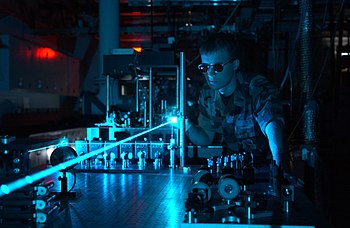
So I finally allotted some time to find out about lasers. What they are, how they work, and what they actually do. I think alot of people take alot of "common" knowledge for granted. I think lasers are an example of this. Everyone "knows" what a laser is, but I doubt if anyone really knows how they function and what they really are. So, here is my (someone else's) best explanation. There is much to be read on the subject, but I feel I am getting close to understanding those wonderful lasers.

A laser is composed of an active laser medium, or gain medium, and a resonant optical cavity. The gain medium transfers external energy into the laser beam. It is a material of controlled purity, size, and shape, which amplifies the beam by the quantum mechanical process of stimulated emission, discovered by Albert Einstein while researching the photoelectric effect. The gain medium is energized, or pumped, by an external energy source. Examples of pump sources include electricity and light, for example from a flash lamp or from another laser. The pump energy is absorbed by the laser medium, putting some of its particles into high-energy ("excited") quantum states. When the number of particles in one excited state exceeds the number of particles in some lower-energy state, population inversion is achieved. In this condition, an optical beam passing through the medium produces more stimulated emission than the stimulated absorption, so the beam is amplified. An excited laser medium can also function as an optical amplifier.

The light generated by stimulated emission is very similar to the input signal in terms of wavelength, phase, and polarization. This gives laser light its characteristic coherence, and allows it to maintain the uniform polarization and monochromaticity established by the optical cavity design.

more from Wikipedia

2009 EDSEL/Lepanto Industries. aLT DELETE. A Division of LABOR CORP. NaDA Publishing.