Showing posts with label science. Show all posts

Wednesday, July 15, 2009

How many computations could the Universe compute if the Universe was a computer

...Which it could be. So if each atom in the available universe could register ONE BIT of information, which they all can as determined by its being "here" or "there", basically its position within the Universe, within the physical system. To compute, bits are flipped. Bits are flipped any time anything within the physical system changes. Any time anything within a system changes, it changes what the information about that system is. For a system to change, for a bit to flip, energy is required. The more energy, the faster a bit can flip. Seth Lloyd in his paper Ultimate Physical Limits to Computation shows that the maximum computational capacity of any system can be figured by running a function of the amount of energy available to the system and the system's size.

To calculate our Cosmic Computational power we have to take the Margolus-Levitin theorem that says that the maximum rate a bit can flip is proportional to the system's energy. So to calculate the maximum bit-flip rate we take the amount of energy available, multiply by 4, and divide by Planck's constant. This will yeild the number of possible bit-flips per second. We then need to find the total amount of energy in our system (E = mc2) E is energy, M is the mass of the system, and c is the speed of light (300 million meters per second). Taking the reasonable estimate of 14 billion years for the age of the Universe from expansion, and light being a finite speed, there is only a finite area of the Universe within it's "horizon" that we can have information about. The horizon grows with time, but will always be of a finite size, even within an infinite universe. To accurate calculations, the horizon of the universe is 42 billion light-years away. On average there is a mass of about one hydrogen atom per cubic meter throughout the Universe. Totaling the energy within the horizon we find that there is approximately 100 million billion billion billion billion billion billion billion (10**71) joules of energy in our Universe. Plugging this into our formula (E * 4 / Planck's Constant) we find that every second the Universe could perform 100,000 googol (10**105) operations. In the 14 billion years of the Universe's history it could have performed about 10,000 billion billion googol ops (10**112).

Compared to our efforts (and estimates) in the whole history of modern computing all the computers on Earth have only performed (according to Seth Lloyd) some fewer than 10 billion billion billion ops (10**30). To quote Terry Jones dressed as a woman whose husband is having his organs removed from him while still alive in The Meaning of Life "makes you feel sort of insignificant doesn't it?"

Friday, August 24, 2007

please take that rash to the doctor


in honor of the us' recent display of its complete inability to deal with infectious disease, among other natural disasters, i thought it might be nice to take a look at how we're doing on a global scale to keep ourselves alive. i am referring here to mr. andrew speaker, the gentleman infected with tuberculosis, who, due to his antibiotic-resistant form of tb, was listed as an international health-risk, and then subsequently was allowed to board a series of international flights from the united states, to canada, to the czech republic. if avian flu becomes transmittable from human to human, we're essentially fucked, but we can't keep one guy with tb from getting on a plane. somehow, this doesn't sound promising.

in any event, according to the World Health Organization,
"With about 2.1 billion airline passengers flying each year, there is a high risk of another major epidemic such as Aids, Sars or Ebola fever." familiar as we are with acquired immune deficiency syndrome and severe acute respiratory syndrome, and perhaps even the ebola virus, we also seem to be simultaneously immune to awareness and/or logic on the subject, due to a constant saturation of fear-style propaganda from the media. this announcement, however, comes not from the media, but from the WHO, a slightly more reputable source.

what is more frightening, though, is not the fact that we are completely unprepared, but the increasing rate with which we are rapidly being confronted with new diseases; "
In the report, A Safer Future, the WHO says new diseases are emerging at the 'historically unprecedented' rate of one per year." the WHO unfortunately seems to give us no solid explanation as to why this is the case. misuse of antibiotics is one factor, but that, of course, would not account for the viral epidemics. inadequate medical care in much of the world (to make no mention of the continual blockages to complete access even here in the united states) may also share in the responsibility.

keep in mind also that these are
new diseases, and we are currently as a global nation unable to deal with the simplest and most curable infections on an international level. "More than 90 percent of the deaths from infectious diseases worldwide are caused by only a handful of diseases. These diseases - lower respiratory infections, HIV/AIDS, diarrheal diseases, tuberculosis, malaria and measles - are also the leading cause of death in sub-Saharan Africa". (http://web.globalhealth.org/view_top.php3?id=228). with the exception of malaria and aids, these are curable.

curable.


if this is not a problem of poverty, i don't know what is.

now, let's take a look at the numbers. in the us alone, defense spending for 2006 was 556,505 million dollars. that looks like a typo, doesn't it? it's not. spending on health, you ask? 56,489 million dollars. how about education? 39,688 million. the basic message that should be gained here is that the nation seems far more concerned with death than with the health or education of its citizens. at least 10 times more concerned. these figures can all be found here: http://www.whitehouse.gov/omb/budget/fy2008/pdf/ap_cd_rom/27_1.pdf

anyone else a little scared about that cough?

Wednesday, August 15, 2007

Decoherrence


Quantum Decoherrence occurs as a particle becomes more entangled with it's environment; removing it from a quantum super position, and "forcing" the particle to behave in a "classical" manner. Dechoerrence is what prevents large objects from exhibiting quantum behavior. The more linked a particle becomes with it's environment (the more information it has given off in the form of photon radiation, or collisions with other particles) the more absolute it becomes. Larger objects cannot maintain a quantum super position because to much decoherrece will have necessarily occurred.

from Decoding the Universe

Wednesday, June 20, 2007

Auto Alchemy


Though the press was all over it last month, I just heard today about Purdue University Professor of Electrical and Computer Engineering Jerry Woodall's discovery that adding an aluminum + gallium solution to water yields hydrogen atoms. The is of particular interest for application to hydrogen fuel cells, and even more specifically to clean internal combustion engines. Previously no solid solution had been found for generating transporting and storing the hydrogen fuel. Woodall's process is safe, clean, and very efficient (two atoms of aluminum yield three atoms of hydrogen). It can be done on site with virtually any quality of aluminum and water (including salt water) and on the spot so hydrogen needn't be stored or transported.

The process is a simple chemical reaction. When water comes into contact with the aluminum pellets in the liquid gallium the hydrogen atoms separate and can be easily collected. Of course the implications are grand. It's clean, easy, safe, efficient, and the ingredients are plentiful. Keep you eyes open for developments.

A bit on the elements while I'm learning stuff. Gallium (Ga) is periodic element 31. It is a metal that melts just above room temperature, and will actually melt in your hands. In the form of gallium nitride and gallium arsenide, it is used as a semi conductor in LED's. It is not naturally occurring, but it easily derived from smelting.

Aluminum (Al 13) is a ductile member of the poor metals family of periodic elements. It is very lightweight and notable for it's ability to resist corrosion. Aluminum is nontoxic, nonmagnetic, and nonsparking.

Hydrogen (H 1) Hydrogen is the lightest and most abundant element making up roughly 75% of the universes' elemental mass. It is odorless, tasteless, nontoxic, and highly flammable. It will also someday hopefully power our lawnmowers and transportation.

Thursday, May 10, 2007

On Breathing Liquid


Unbelievably, I saw the movie the Abyss for the first time last night. In this film, as the rest of you know, they breath liquid to keep their lungs from collapsing below 2 miles of ocean. I was aware of the concept, but unclear on it's validity and history, so of course, I found out.

It turns out the concept is mostly sound. The lungs can be filled with oxygen rich solutions and function relatively normally. The problem arises in the expulsion of excess carbon dioxide. This was initially circumvented by keeping the liquid at incredibly low temperatures. One subject mouse survived for over 20hours breathing liquid at 18 degrees celcius. This is a problem however because it would induce hypothermia in the animals, and would not serve as a functional application. Unfortunately almost all animals tested have suffered varying degrees of lung damage. There have been some advancements in the application in recent years.

from Wikipedia

During later years, the techniques of liquid breathing were constantly refined and improved. The survival rate of all the tested animals in recent years has been very high, thanks mainly to improvements in carbon dioxide elimination. Current liquids used can dissolve over 65 ml of oxygen and 228 ml of carbon dioxide per 100 ml perfluorocarbon. By the early 1990s this procedure was developed:

1. The animal was anesthetized with intravenous sodium thiopental.
2. The animal was put on its back. A tube was placed down its airway, ready for the liquid breathing medium.
3. A blood sample was taken. The temperature of the liquid was adjusted correspondingly. It was no longer necessary to make the animals hypothermic.
4. The perfluorocarbon was instilled into the animal's lungs through the tube.
5. A floor-mounted 3-litre reservoir was filled with the perfluorocarbon. The liquid was driven by a pump through a series of machines which warmed and oxygenated the liquid and took the carbon dioxide out of it. The liquid flowed through a tube into a 3-way pneumatic valve which directed flow to the animal. A computer controlled the respiration (18 ml of fluid per second), pumping the liquid into the animal's lungs, then back out again to the reservoir, at a rate of about 6 complete respirations per minute.
6. At the end of the test, the animal was tilted for about 15 seconds and the perfluorocarbon was allowed to drain from the lungs. This can be seen in the film The Abyss where Ensign Monk drained the liquid out of the rat's lungs: in the filming, the rat genuinely breathed liquid.

These tests of the early 90s were successful: dogs could be kept alive in the perfluorcarbon medium for about 2 hours; after removal the dogs were usually slightly hypoxic, but returned to normal after a few days. When the animals were necropsied, the typical findings were mild oedema and some hemorrhaging, clearly an improvement over the lung damage of earlier tests.


The application of liquid breathing in human medicine, deep sea diving, and space travel is still speculative, but perhaps some day we will all get the opportunity to breath liquid. The mouse at the top is alive by the way.

Tuesday, May 01, 2007

Just a Second

Not just Mississippi.

Under the International System of Units, the second is currently defined as the duration of 9,192,631,770 periods of the radiation corresponding to the transition between the two hyperfine levels of the ground state of the caesium-133 atom.[1] This definition refers to a caesium atom at rest at a temperature of 0 K (absolute zero). The ground state is defined at zero magnetic field.[1] The second thus defined is equivalent to the ephemeris second.

The international standard symbol for a second is s (see ISO 31-1)

Originally, the second was known as a "second minute", meaning the second minute (i.e. small) division of an hour. The first division was known as a "prime minute" and is equivalent to the minute we know today.

The factor of 60 comes from the Babylonians who used factors of 60 in their counting system. However, the Babylonians did not subdivide their time units sexagesimally (except for the day). The hour had been defined by the ancient Egyptians as either 1/12 of daytime or 1/12 of nighttime, hence both varied with the seasons. Hellenistic astronomers, including Hipparchus and Ptolemy, defined the hour as 1/24 of a mean solar day. Sexagesimally subdividing this mean solar hour made the second 1/86,400 of a mean solar day.[citation needed] Hellenistic time periods like the mean synodic month were usually specified quite precisely because they were calculated from carefully selected eclipses separated by hundreds of years—individual mean synodic months and similar time periods cannot be measured. Nevertheless, with the development of pendulum clocks keeping mean time (as opposed to the apparent time displayed by sundials), the second became measurable. The seconds pendulum was proposed as a unit of length as early as 1660 by the Royal Society of London. The duration of a beat or half period (one swing, not back and forth) of a pendulum one metre in length on the earth's surface is approximately one second.[2]

In 1956 the second was defined in terms of the period of revolution of the Earth around the Sun for a particular epoch, because by then it had become recognized that the Earth's rotation on its own axis was not sufficiently uniform as a standard of time. The Earth's motion was described in Newcomb's Tables of the Sun, which provides a formula for the motion of the Sun at the epoch 1900 based on astronomical observations made between 1750 and 1892.[1] The second thus defined is

the fraction 1/31,556,925.9747 of the tropical year for 1900 January 0 at 12 hours ephemeris time.[1]

This definition was ratified by the Eleventh General Conference on Weights and Measures in 1960. The tropical year in the definition was not measured, but calculated from a formula describing a tropical year which decreased linearly over time, hence the curious reference to a specific instantaneous tropical year. Because this second was the independent variable of time used in ephemerides of the Sun and Moon during most of the twentieth century (Newcomb's Tables of the Sun were used from 1900 through 1983, and Brown's Tables of the Moon were used from 1920 through 1983), it was called the ephemeris second.[1]

With the development of the atomic clock, it was decided to use atomic clocks as the basis of the definition of the second, rather than the revolution of the Earth around the Sun.

Following several years of work, Louis Essen from the National Physical Laboratory (Teddington, England) and William Markowitz from the United States Naval Observatory (USNO) determined the relationship between the hyperfine transition frequency of the caesium atom and the ephemeris second.[1] Using a common-view measurement method based on the received signals from radio station WWV,[3] they determined the orbital motion of the Moon about the Earth, from which the apparent motion of the Sun could be inferred, in terms of time as measured by an atomic clock. As a result, in 1967 the Thirteenth General Conference on Weights and Measures defined the second of atomic time in the International System of Units (SI) as

the duration of 9,192,631,770 periods of the radiation corresponding to the transition between the two hyperfine levels of the ground state of the caesium-133 atom.[1]

The ground state is defined at zero magnetic field. The second thus defined is equivalent to the ephemeris second.[1]

The definition of the second was later refined at the 1997 meeting of the BIPM to include the statement

This definition refers to a caesium atom at rest at a temperature of 0 K.

The revised definition would seem to imply that the ideal atomic clock would contain a single caesium atom at rest emitting a single frequency. In practice, however, the definition means that high-precision realizations of the second should compensate for the effects of the ambient temperature (black-body radiation) within which atomic clocks operate and extrapolate accordingly to the value of the second as defined above.


via Wikipedia

Friday, April 20, 2007

Crosse's Acari


I have in my collection a book entitled "Oddities" which is a bit of an oddity in it's own right. In it, numerous tales of unexplained intrigue can be found, however rudimentary investigation in the past has revealed the book to be one of a few, if not the only source on most of the subjects. Such as appears to be the case in the story of Crosse's Acari. Andrew Crosse was an amateur scientist studying electricity in relative seclusion in the North of England in the first half of the 19th century. Inexplicably, and unexplainably, because his records were lost, in studying the effects of electrical current on a crystal he noticed that tiny aphids, or acari had sprouted from the surface of the rock. He continued his experiments and before long was overrun by literally hundreds of the little blighters.

From his own account:

"On the fourteenth day from the commencement of this experiment I observed through a lens a few small whitish excrescences or nipples, projecting from about the middle of the electrified stone. On the eighteenth day these projections enlarged, and struck out seven or eight filaments, each of them longer than the hemisphere on which they grew.

"On the twenty-sixth day these appearances assumed the form of a perfect insect, standing erect on a few bristles which formed its tail. Till this period I had no notion that these appearances were other than an incipient mineral formation. On the twenty-eighth day these little creatures moved their legs. I must now say that I was not a little astonished. After a few days they detached themselves from the stone, and moved about at pleasure.

"In the course of a few weeks about a hundred of them made their appearance on the stone. I examined them with a microscope, and observed that the smaller ones appeared to have only six legs, the larger ones eight. These insects are pronounced to be of the genus acarus, but there appears to be a difference of opinion as to whether they are a known species; some assert that they are not. [See Fig. 1]

"I have never ventured an opinion on the cause of their birth, and for a very good reason—I was unable to form one. The simplest solution of the problem which occurred to me was that they arose from ova deposited by insects floating in the atmosphere and hatched by electric action. Still I could not imagine that an ovum could shoot out filaments, or that these filaments could become bristles, and moreover I could not detect, on the closest examination, the remains of a shell...

"I next imagined, as others have done, that they might originate from the water, and consequently made a close examination of numbers of vessels filled with the same fluid: in none of these could I perceive a trace of an insect, nor could I see any in any other part of the room."


He abandoned his studies due to the amount of scorn and ridicule that befell him after publishing his findings. It should be noted that no similar cases have since occurred. What did Crosse know that no one else did. Here is a link to the entire story as related in the book Oddities for you continued learning.

Tuesday, March 20, 2007

Nocebo

This will come in handy later:

n its original application, "nocebo" had a very specific meaning in the medical domains of pharmacology, and nosology, and aetiology.

It was a subject-oriented adjective that was used to label the harmful, injurious, unpleasant, or undesirable reactions (or responses) that a subject manifested (thus, "nocebo reactions" or "nocebo responses") as a result administering an inert dummy drug, where these responses had not been chemically generated, and were entirely due to the subject's pessimistic belief and expectation that the inert drug would produce harmful, injurious, unpleasant, or undesirable consequences.

In these cases, there is no "real" drug involved, but the actual harmful, injurious, unpleasant or undesirable biochemical, physiological, behavioural, emotional, and/or cognitive consequences of the administration of the inert drug are very real.

A "classic" example of the nocebo response is someone dying of fright after being bitten by a non-venomous snake.


From Wikipedia

Friday, March 16, 2007

Current-ly


So I watched Finding Nemo the other night with my sick girlfriend, which got me thinking about the EAC (Eastern Australian Current) that they ride into Sydney in the movie. Specifically, if it really looks and behaves like that. Here's what I found out:

Ocean currents can flow for thousands of kilometers. They are very important in determining the climates of the continents,especially those regions bordering on the ocean. Perhaps the most striking example is the Gulf Stream, which makes northwest Europe much more temperate than any other region at the same latitude. Another example is the Hawaiian Islands, where the climate is somewhat cooler (sub-tropical) than the tropical latitudes in which they are located because of the California Current.

Surface ocean currents are generally wind driven and develop their typical clockwise spirals in the northern hemisphere and counter-clockwise rotation in the southern hemisphere because of the imposed wind stresses. In wind driven currents, the Ekman spiral effect results in the currents flowing at an angle to the driving winds. The areas of surface ocean currents move somewhat with the seasons; this is most notable in equatorial currents.

Deep ocean currents are driven by density and temperature gradients. Thermohaline circulation, also known as the ocean's conveyor belt, refers to the deep ocean density-driven ocean basin currents. These currents, which flow under the surface of the ocean and are thus hidden from immediate detection, are called submarine rivers. These are currently being researched by a fleet of underwater robots called Argo. Upwelling and downwelling areas in the oceans are areas where significant vertical movement of ocean water is observed.

Ocean currents are measured in Sverdrup with the symbol Sv, where 1 Sv is equivalent to a volume flow rate of 106 cubic meters per second.


So, the movie about animated talking fish looking for a lost son has embellished slightly. I think I'm going to boycott Pixar.

from Wikipedia

Friday, February 23, 2007

the MEM Meme


Technological expansion is a multi-dimensional cloud spreading in all directions. Not only through time, but forward and back, up and down, very large and very small. Very small as in Nanotech. Intrinsically, nanotechnology must be composed of something, that something is a type nanomechanics called MEMS.

Microelectromechanical Systems (MEMS) is the technology of the very small, and merges at the nanoscale into "Nanoelectromechanical" Systems (NEMS) and Nanotechnology.

MEMS are also referred to as micromechanics, micro machines, or Micro Systems Technology (MST). MEMS are separate and distinct from the hypothetical vision of Molecular nanotechnology or Molecular Electronics.

MEMS generally range in size from a micrometer (a millionth of a meter) to a millimeter (thousandth of a meter). At these size scales, the standard constructs of classical physics do not always hold true. Due to MEMS' large surface area to volume ratio, surface effects such as electrostatics and wetting dominate volume effects such as inertia or thermal mass.


But we can now go even one better than that. If MEMS are too large and cumbersome, we can drop down to NEMS.

So the future for human advancement then, appears to be very small.

From Wikipedia.

Saturday, February 17, 2007

Hair yesterday gone tomorrow.


Today on a bus ride back to Indianapolis (why do I keep coming back?) I finished up the excellent book, Mutants by: Armand Marie Leroi. In it many topics of extreme fascination, many of them I have looked into more, but one that struck me as quite a bit queer was the description of "lanugo hair."

From Wikipedia:

Lanugo are hairs that grow on the body to attempt to insulate it because of lack of fat. It is a type of pelage. It occurs on fetuses and it is normal for the unborn fetus to consume the hair, which then contributes to the newborn baby's first feces (meconium). Lanugo hair is usually shed and replaced by vellus hair at 36–40 weeks gestation. The presence of lanugo in newborns is a sign of premature birth.

It is also a common symptom of serious anorexia nervosa, as the body attempts to insulate itself as body fat is lost.


It just seems strange to think that for a period of our development, we're floating around completely covered in downy translucent hair that mostly goes away by the time we come out. Who knew. Now I do, and so do you. ...unless you just read that last sentence, then you don't know what I know.

Wednesday, February 14, 2007

Pedicle Tubing


I have been tracking in awe through the galleries at Project Facade; a exhaustingly comprehensive collection of the facial reconstruction procedures developed for victims of World War I. The project came out of the Gillies Archives at the Queen Mary Hospital in Sidcup, just southeast of London. Project Facade is an exhausting collection of arresting images, terrible injuries, and incredible repairs. While browsing the case studies and galleries you will come into constant contact with images of and references to "pedicle tubing." It is an obvious term, but the true use and nature of the procedure is not as immediately apparent. Here is a full definition of the procedure from Project Facade:

The tube pedicle was developed simultaneously yet independently by Sir Harold Gillies at the Queen’s Hospital Sidcup and ophthalmic surgeon Vladimir Petrovich Filatov in Odessa, Russia between 1916 and 1917. A tube pedicle is a flap of skin sewn down its long edges, with one end left attached to the site of origin, the other is attached to the site to be grafted.

The procedure begins with the lifting of a long, large flap of skin by making a roughly ‘U’ shaped incision. The rounded end of the flap is cut to shape to fit the area to be repaired. The long edges of the skin flap are stitched together to form a tube to prevent drying out and infection of the raw side of the skin flap. The shaped end of the tube is then attached to the site to be repaired whilst the other end of the tube remains attached to its site of origin. After a number of weeks, the tube is cut near the area to be repaired leaving enough skin on the graft site to shape and model. The remainder of the tube can once again be opened and returned to its original position. On occasion, multiple tubes might be taken to rebuild substantial parts of the face or body.

Tissue must be taken from distant parts of the body in stages. For example a tube might be taken from the stomach area and attached to the wrist. After a number of weeks the tube would be disconnected from the stomach, the arm raised and the loose end of the tube attached to the site on the face to be repaired. Once again after a number of weeks the tube is disconnected from the wrist and this loose end of the tube is attached to another part of the face. Only then can the tube be opened and modelled to the face.


Sir Harold Gillies is a fascinating study in his own right. He not only pioneered facial reconstruction and plastic surgery, but preformed the both first sex reassignment surgery from female to male in 1946 and from male to female in 1951. To the strong stomached, I highly recommend browsing around Project Facade. The more you explore the more the accomplishments of these pioneers of plastic surgery begin to shock more than the unimaginable damage suffered by the poor soldiers.

From: Project Facade

Thursday, February 08, 2007

Sonic (the) Hedgehog


I read today of a signaling protein named "sonic hedgehog." This is a startling name for a signaling protein for anyone out of the 16bit generation such as myself. It was apparently dubbed "hedgehog" when it was discovered in the 1980's to produce a spiny mutation in fruit fly larva. In the 90's it was discovered to be present in vertebrates and was given the "sonic" qualifier by a postgraduate with a propensity for gaming. Lack or deficiency of the sonic gene is responsible for dividing the forebrain into its two hemispheres. Failure of hemisphere division results in a condition known as holoprosencephaly meaning "whole forebrain" or cyclopia.

From: Mutants

Tuesday, January 30, 2007

Plant-ation


My roommate returned today with stories of plant perception and alleged that even discussing this subject was setting any plant hooked up to a lie detector in the tri-state area off the charts. This was all reported from a zine he picked up on his travels chronicling the discovery of Cleve Backster that plants hooked up to a GSR (galvanic skin response) analyzer registered huge spikes when you even thought about... lots of stuff: fire, not watering them, watering them, undressing them, etc. The plants, Backster found, could pick human thoughts out of the ether. This would give much credence to such theories as divining, lay lines, auras, and energy fields. He also thought that yogurt (of the same culture) could communicate.

I was intrigued. I've been reading a bit about the nature of time, and the possibility that linear time might not exist. Read about entangled particles and try and go to sleep. But anyway,I decided that that would be my knowledge for the night. After spending the day reading and viewing various skeptical publications, I jumped into the so-called Backster Effect.

Unbelievably, it seems his finding are highly dubious.

Basically it was found that plants respond more to the thought of being cut, burned, or torn than to the actual act. He discovered that if he tore a leaf from one plant a second plant would respond, but only if he was paying attention to it. The plants seemed to be mirroring his own mental responses. He concluded that the plants were acting like batteries, storing the energy of his thoughts and intentions. He said of these experiments: “I learned that there is energy connected with thought. Thought can be pulsed and the energy connected with it becomes coherent and has a laser-like power


He has been debunked numerous times since, "The Secret Life of Plants" was published in 1973. Most recently by the Mythbusters. It appears his findings could never be satisfactorily replicated in control experiments, to which he would contest that the plants were not properly attuned to the environment or researchers. He seems to be guilty of the blunder of false correlation. There is nothing to suggest that the plants were reacting to human thought; only human thought connects the two.

Now if we could just figure out this time thing...

more at:
Wikipedia: Plant Perception
James Randi Encyclopedia
Skeptics Dictonary
A pro-Backster Article

Wednesday, January 24, 2007

Seeking knowledge

I know I'm not going to find it here. I think I've had all of 1 comment ever on this blog, but I don't do this for you, and even if I did, maybe I just wanted to get your little gears a' turnin tonight. That being said, I would like to offer a reward of something very cool mailed to the address of whosoever can provide for me a satisfactory explanation of the following quandary that I have been pondering for well on a year now:

My friends and I have wavered back and fourth for some time on the notion of attaching a rope, or tether, or similar device to the surface of the Moon, across space, and into the Earth's gravitational pull. The tether would not, however be attached to the surface of the Earth. If the cord was of considerable length, would it simply traverse the Earth's surface as the Moon orbited, and at certain points (when the distance of the moon to the Earth and the elevation were right) would there just be an end of a rope coming out of the sky that passers by could grab onto, and thus hold something attached to the Moon? As I had cautioned, it is a flight of fancy, but still an intriguing scenario. For fun, I posed this question to NASA about a year ago. 5 months later I received a note directing me to some websites that covered the concept of a "space lazer" more in depth. This was not a satisfactory response, so I have no choice but to torment others who are more versed in physics than my education in animation has afforded me.

The above e-mail was sent and never returned from Professor Rocky Kolb from the University of Chicago Physics department. I attended a lecture of his and hoped he would finally illuminate me on this hypothetical, but sadly, he didn't. Are we to remain in the dark forever?

Bonus: If you satisfactorily describe what would happen if the rope were teathered to the Earth as well.

you may also respond to my post on the Nova board

Friday, January 19, 2007

Meat Plants


I've been reading today about meat culturing. It's becoming more and more likely that we will soon be able to synthesize meat sans animal. The study was spearheaded by NASA in June of 2005 along with the University of Maryland. They are able to successfully grow meat by culturing muscle cells in a lab setting. The muscles still must be "exercised" so they maintain some form other than mush, but he implications are staggering. If this could be widely applied, it would probably be much cheaper, and certainly more humane than tending livestock. Vegetarians would have some things to think about. Everyone would. It's definitely in the realm of frankenfood, but the implications are quite interesting. The texture is still a little dodgy, but last week, a team of scientists cooked up a "chicken breast" if that's what you want to call it, in some oil and spices. The agreed that it smelled "quite delicious" but refrained from chowing down.

From: University of Maryland
and BBC

Saturday, January 13, 2007

Stephen King, liar.

Recently, I watched Pet Sematary for the first time. I know, a rather large gap to have left in my horror movie education, but what's done is done, and what isn't isn't. My suspicious were aroused at the point in the movie where Tasha Yar's sister has been turned into a hideous skeletal zombie creature and locked in a room upstairs for years because of spinal meningitis. This struck me as a mite queer remembering how a friend of a friend had succumbed to the "same" illness in the course of an evening. As I remembered it, in the case I had heard about, the kid just went to sleep complaining of a stiff neck and never woke up. Didn't begin to resemble a corpse until after he died.
Through the magic of basic research, I have discovered that there are different forms of Meningitis, viral, bacterial, or fungal, but all of them affect the meninges: the system of membranes that envelop the central nervous system. Bacterial Meningitis is particularly serious form will kill within 24 hours without prompt medical treatment (in the form of strong antibiotics, or steroids).

Here is a list of symptoms associated with Meningitis from Wikipedia:

Symptoms of meningitis are: Sudden high fever, drowsiness or confusion, severe, unrelenting headache, stiff neck, intolerance to bright light and sounds, twitching, convulsions, delirium particularly in children, and/or a rash of small, irregular purple or red spots all over the body may indicate meningococcal meningitis. Chills, nausea, or vomiting, may also occur. Seizures may occur in about 20 to 40% of patients. Other signs include Kernig's sign and Brudzinski's sign. Although commonly tested, the sensitivity and specificity of Kernig's and Brudzinski's tests are uncertain.


Spinal Meningitis, though serious, is not a chronic illness. I think Zelda was misdiagnosed:

Either that or Stephen King just opened up his "Big Book of Medical Ailments" and picked something that sounded good. Don't trust everything you see in pulp horror.

See also:
Understanding Meningitis
Mayo Clinic: Meningitis
Wikipedia:Meninges

Saturday, December 23, 2006

Solar Cycle 24: The Death of Us All


Today I learned that the Mayans were right and we're all going to die in 2012 during solar Cycle 24. Although we probably wont die of that. Solar cycles are regular 11 year fluctuation in the Sun's magnetic field. The next one coming is going to be the biggest one in the recorded history of Sun (or as I like to call them, FUN cycles)! What this means is that starting around 2010, don't trust your compass, and keep your eyes trained on the night sky for the Northern Lights (probably as far South as Brazil).

The solar Maximum is the period we are concerned with.That is when the Sun's magnetic field is at it's strongest, and sunspots appear due to inconsistencies in said field. The field gets all fucked up and collides with Earth's field causing phenomena such as the Northern Lights and the Loch Ness Monster.

Anyway, if you want to read more about how we're probably going to die go here:
Physorg
Wikipedia: Solar Cycle
Wikipedia: Solar Maximum

Friday, December 22, 2006

the God Experiments


These took place back in the 80's. I couldn't remember who conducted the study, so I looked it up. The studies were conducted by Dr. Michael Persinger. The results of the tests found that 80% of the subjects tested sensed an "ethereal presence" which differed depending on the subjects cultural background. I.E. God, aliens, angels, Buddha, Vishnu, Allah, or whatever else helps you get to sleep at night. IN effect this reveals that "religious experience" is nothing more than human experience. Read these for more:

Discover: God Experiments
God and the Temporal Lobes
Wikipedia: God Helmet

Friday, November 17, 2006

getting my lasers on


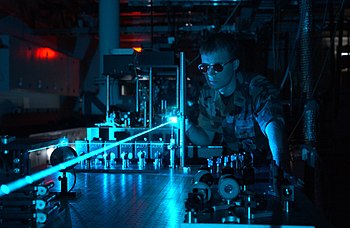
So I finally allotted some time to find out about lasers. What they are, how they work, and what they actually do. I think alot of people take alot of "common" knowledge for granted. I think lasers are an example of this. Everyone "knows" what a laser is, but I doubt if anyone really knows how they function and what they really are. So, here is my (someone else's) best explanation. There is much to be read on the subject, but I feel I am getting close to understanding those wonderful lasers.

A laser is composed of an active laser medium, or gain medium, and a resonant optical cavity. The gain medium transfers external energy into the laser beam. It is a material of controlled purity, size, and shape, which amplifies the beam by the quantum mechanical process of stimulated emission, discovered by Albert Einstein while researching the photoelectric effect. The gain medium is energized, or pumped, by an external energy source. Examples of pump sources include electricity and light, for example from a flash lamp or from another laser. The pump energy is absorbed by the laser medium, putting some of its particles into high-energy ("excited") quantum states. When the number of particles in one excited state exceeds the number of particles in some lower-energy state, population inversion is achieved. In this condition, an optical beam passing through the medium produces more stimulated emission than the stimulated absorption, so the beam is amplified. An excited laser medium can also function as an optical amplifier.

The light generated by stimulated emission is very similar to the input signal in terms of wavelength, phase, and polarization. This gives laser light its characteristic coherence, and allows it to maintain the uniform polarization and monochromaticity established by the optical cavity design.

more from Wikipedia

2009 EDSEL/Lepanto Industries. aLT DELETE. A Division of LABOR CORP. NaDA Publishing.